The Reactivity Trap: Why Most Investors Are Looking in the Rearview Mirror
The primary failure of modern capital allocation lies in a systemic misunderstanding of time horizons. Most market participants spend their intellectual energy parsing yesterday’s headlines or reacting to data points that have already been digested by the collective consciousness of the tape. In an environment defined by high-frequency execution and instantaneous information dissemination, the traditional "news cycle" is an evolutionary relic. By the time a narrative reaches the mainstream consensus, the alpha has been extracted, leaving the reactive investor to provide exit liquidity for those who correctly mapped the structural shifts months prior. This is the inescapable reality of a system where markets are discounting mechanisms.
To move beyond the noise, one must transition from a narrative-driven approach to a condition-based systematic process.
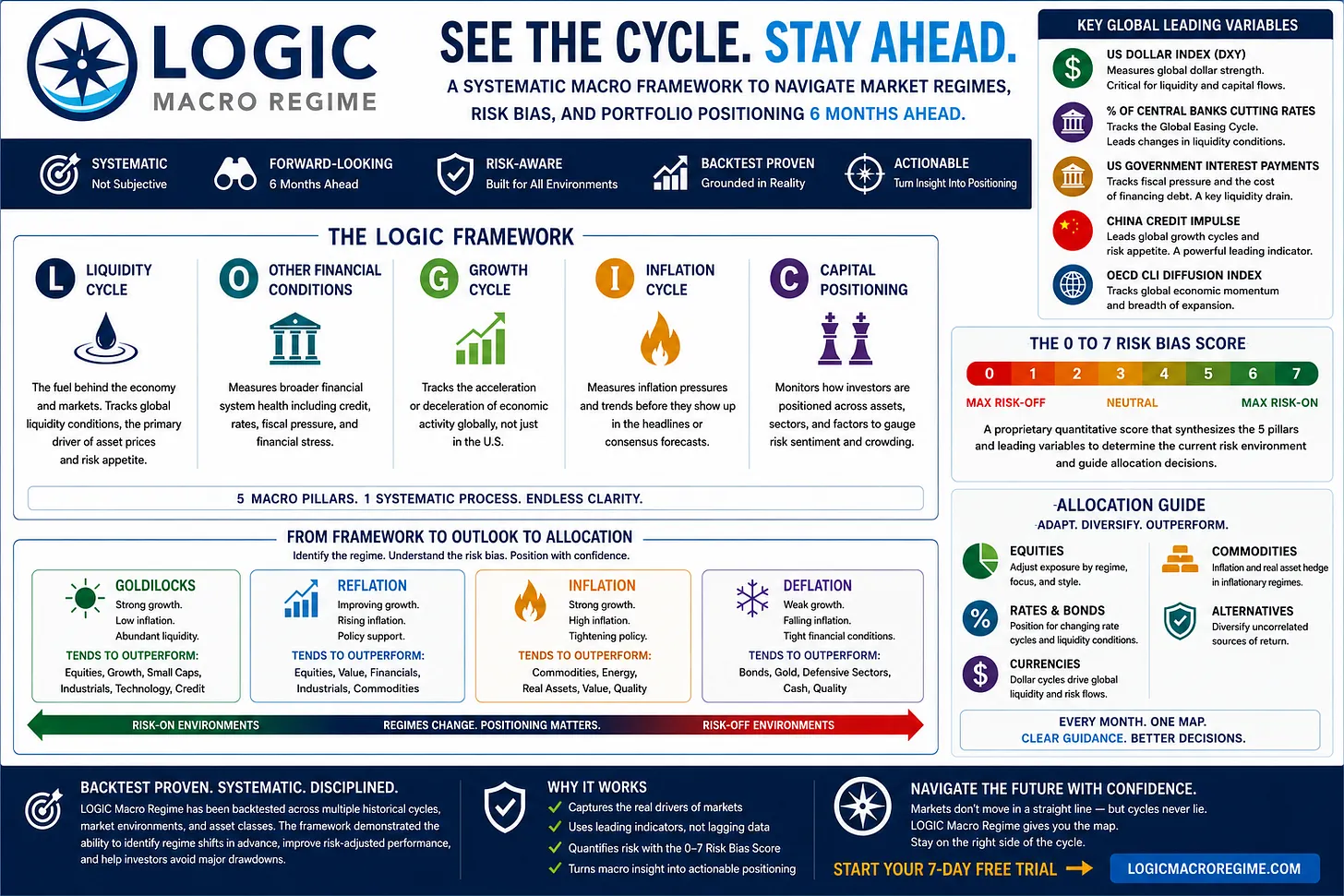
The solution is "LOGIC Macro Regime" - a rigorous framework designed to identify shifts in global liquidity and economic regimes six months before they manifest in headline volatility. Rather than guessing the "why" behind a price move after the fact, LOGIC focuses on the "how" - the underlying plumbing and monetary velocity that dictate market direction. This framework allows for a proactive stance, identifying the next regime while the crowd is still debating the previous one.
The following takeaways delineate how global markets actually function in an era of fiscal dominance. We will move beyond the superficiality of traditional earnings fundamentals to examine the systematic gears - liquidity, growth, and positioning - that drive the global macro environment.
The goal is simple: to provide a macro navigation system that replaces human intuition with institutional rigor.
Takeaway #1: Liquidity is the Lead Actor, Not a Supporting One
In the current era of "financialization" and "fiscal dominance," the traditional focus on company-specific fundamentals is increasingly insufficient. We have entered a regime where debt dynamics and the global liquidity cycle are the primary determinants of asset prices. When global debt-to-GDP reaches current extremes, the system becomes hypersensitive to the availability of collateral and the expansion of central bank balance sheets.
Liquidity is not merely a technical factor; it is the fundamental precursor to volatility and asset price discovery. It is the leading variable that determines whether the "real economy" can service its obligations and whether financial assets can sustain their multiples. In a world of high leverage, the rate of change in liquidity precedes the rate of change in earnings.
"Liquidity is the fuel behind both the real economy and financial assets."
Takeaway #2: The "LOGIC" Behind the Market’s Madness
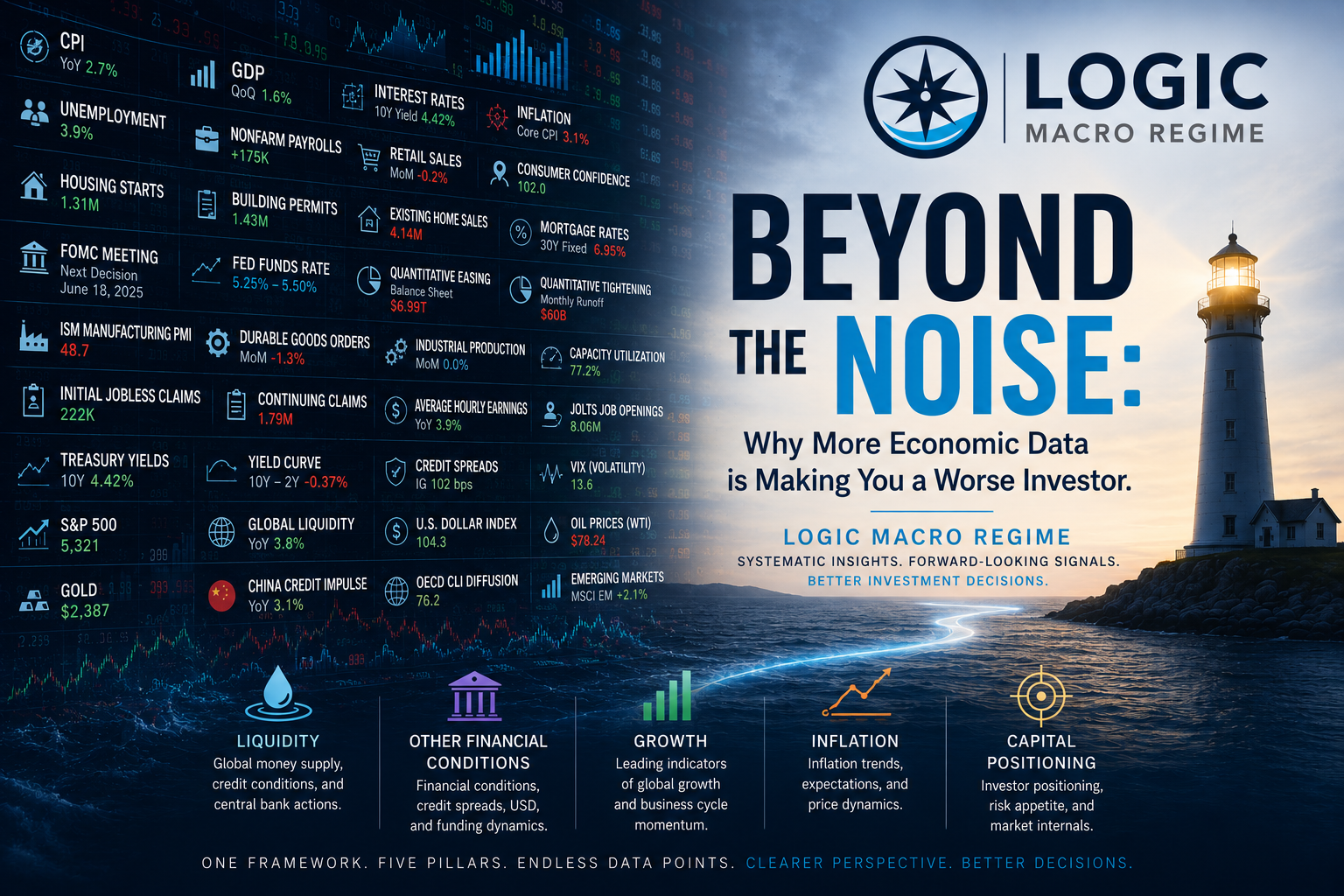
The LOGIC framework is built on five distinct pillars that, when synthesized, provide a forward-looking map of the investment landscape. Unlike single-variable models, this multi-pillar approach identifies the "why" and "when" of regime shifts by analyzing the interaction between monetary and economic forces.
Liquidity Cycle (L): This measures the expansion and contraction of the global money supply and central bank balance sheets. It matters because it is the leading indicator of asset price volatility; as liquidity contracts, systemic risk rises.
Other Financial Conditions (O): This tracks credit spreads, lending standards, and currency volatility. It leads markets by identifying the "ease" of capital flow; when conditions tighten, it signals an impending slowdown in growth and a shift toward defensive positioning.
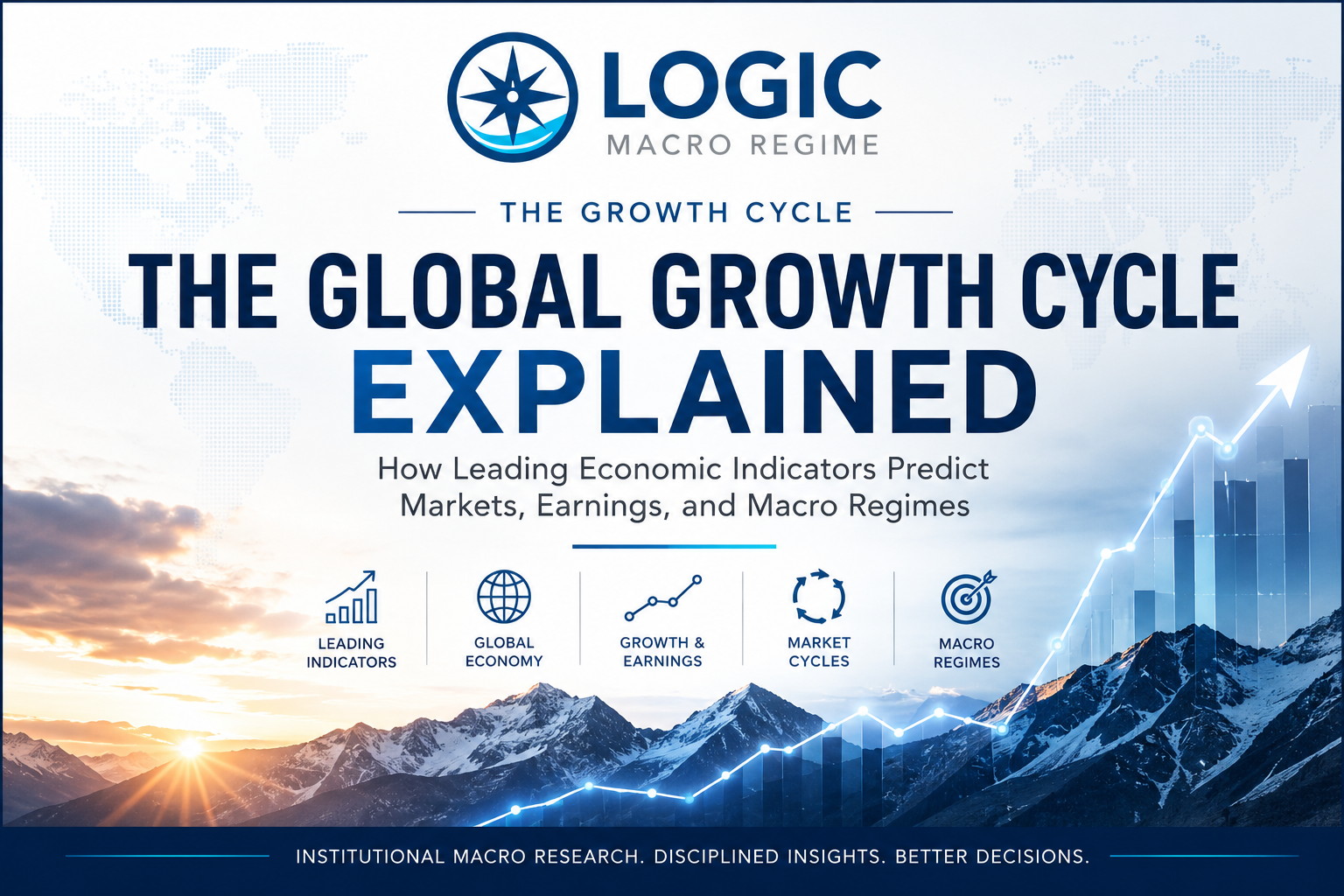
Growth Cycle (G): This identifies the direction and rate of change (ROC) of economic output. By focusing on the second derivative of growth rather than absolute levels, it allows investors to anticipate the transitions between reflationary and deflationary environments.
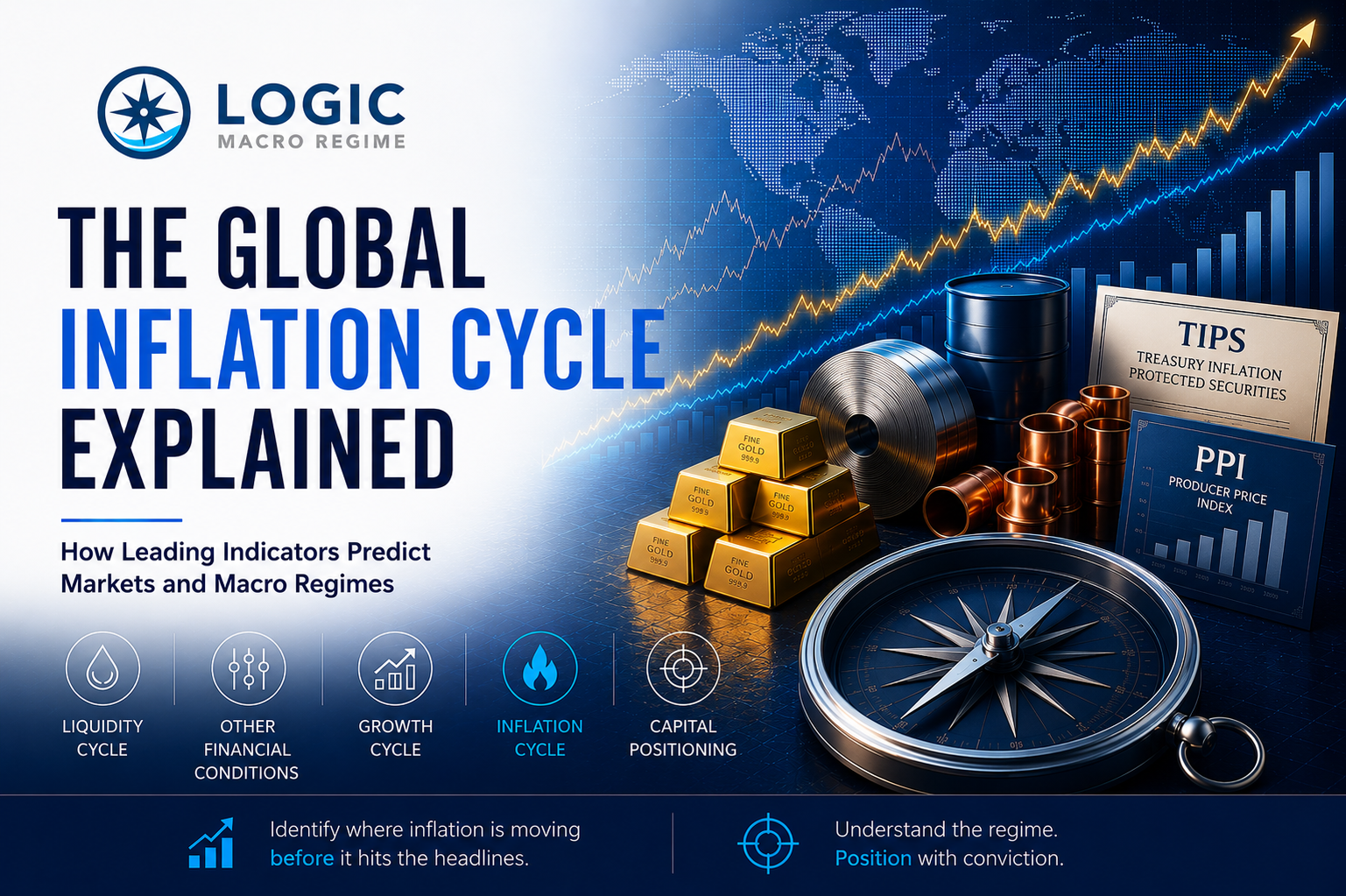
Inflation Cycle (I): This monitors the purchasing power of currency and pricing pressures. It influences future regimes by dictating central bank reactions; sticky inflation limits the "liquidity put," forcing a different asset leadership than a low-inflation environment.
Capital Positioning (C): This analyzes how investors are currently allocated across asset classes. It is critical for identifying "crowded trades" that are structurally vulnerable to reversals, even if the macro backdrop remains favorable.
Investors often underestimate these pillars because they focus on lagging "hard" data. In contrast, the LOGIC framework utilizes these as leading indicators to determine the path of least resistance for capital.
Takeaway #3: The Five Variables the Crowd Ignores
While the consensus focuses on the Federal Reserve’s latest press release, the LOGIC framework monitors five "Key Global Leading Variables" that provide a more granular view of the global liquidity cycle. These variables do not operate in isolation; their synergy creates the "liquidity pincer" that dictates regime shifts.
US Dollar Index (DXY): The global reserve currency acts as a wrecking ball for international liquidity when it strengthens, tightening global collateral constraints.
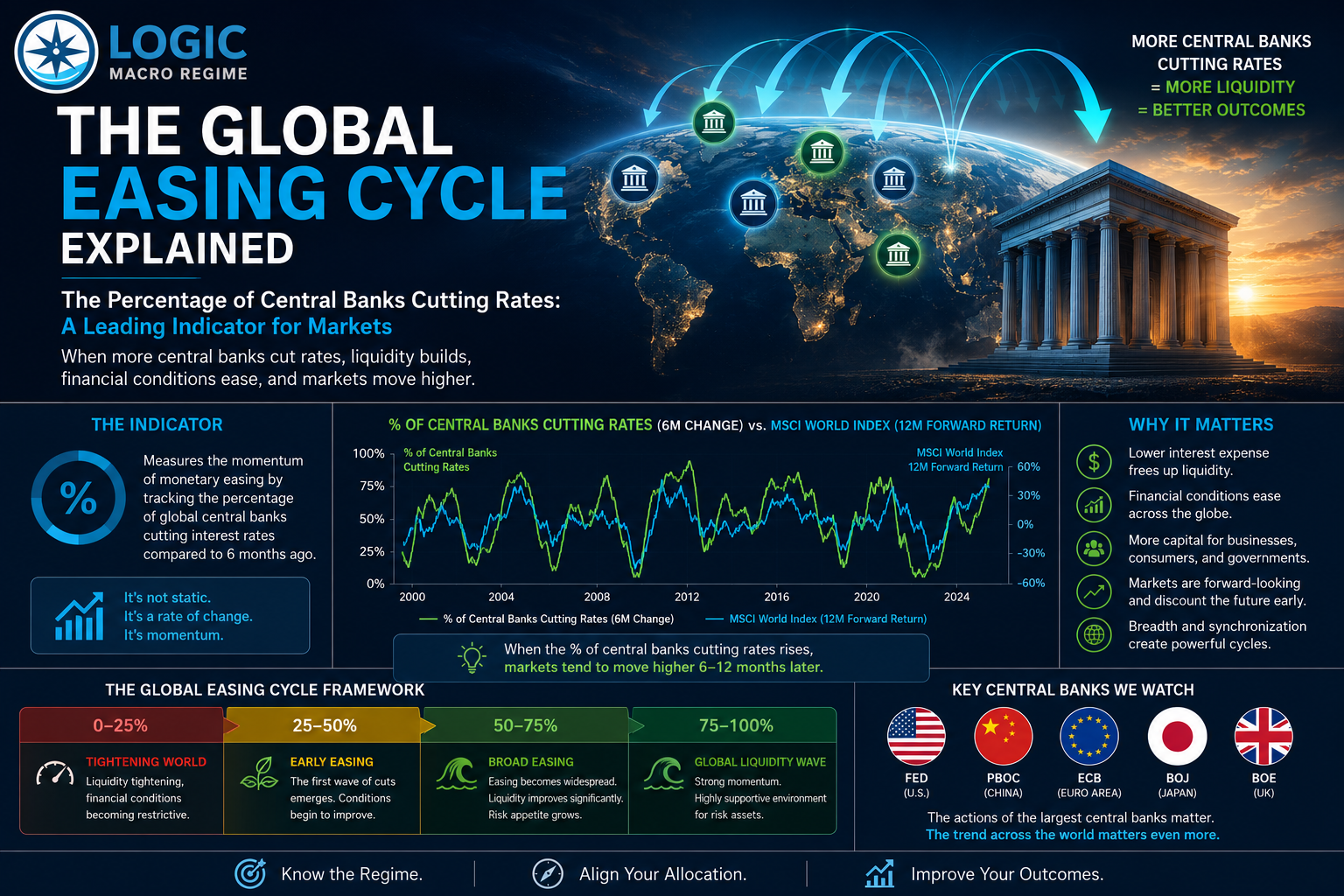
Percentage of Central Banks Cutting Rates: This tracks the Global Easing Cycle. When this percentage rises, it signals a systemic shift toward liquidity expansion.
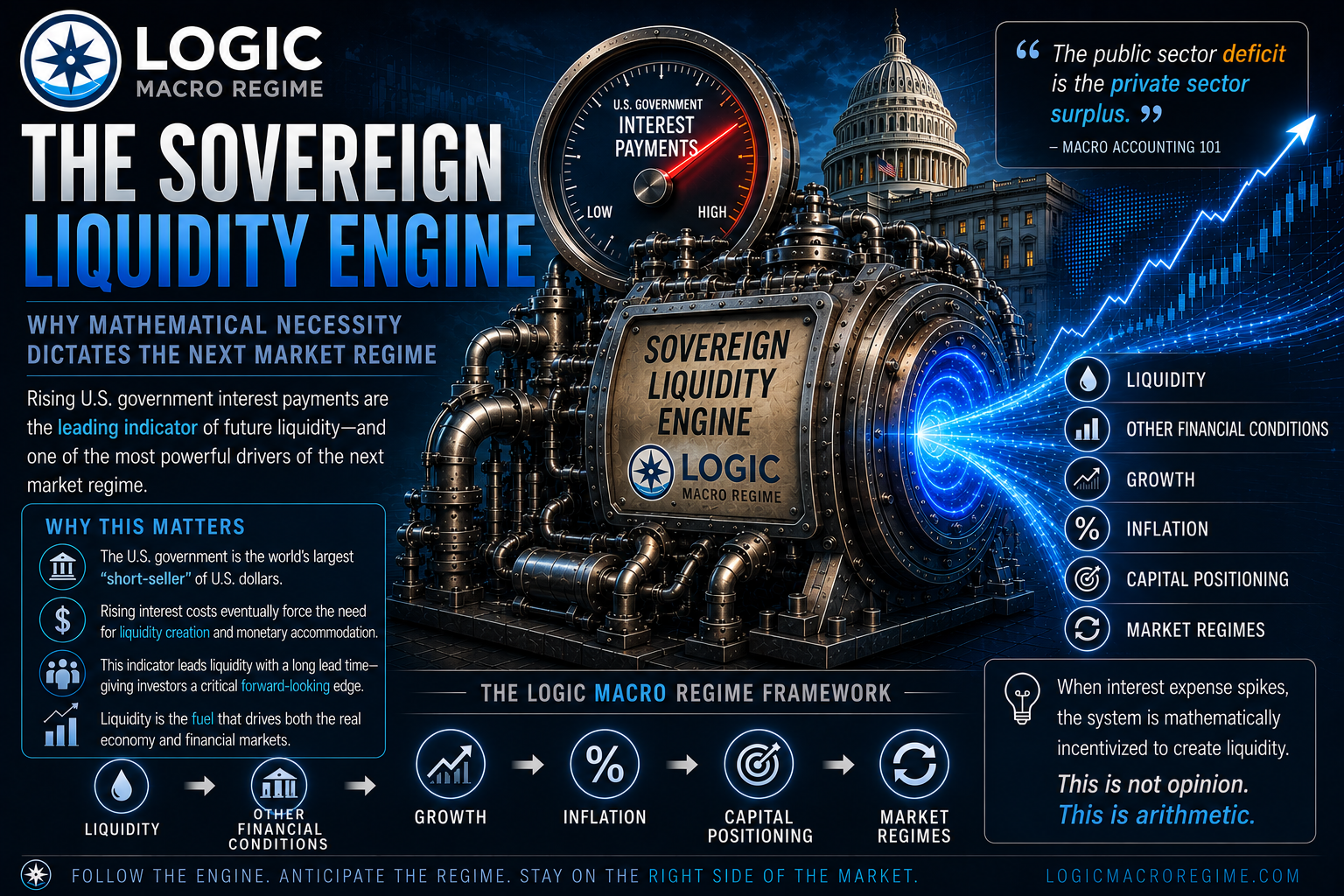
US Government Interest Payments: A critical measure of fiscal dominance. As interest costs consume more of the federal budget, it forces specific monetary responses that can paradoxically increase liquidity through "fiscal QE."
China Credit Impulse: This is the primary lead for global manufacturing and commodity demand. It measures the change in the rate of new credit, often leading the global OECD growth cycle by 6–9 months.
OECD CLI Diffusion Index: A broad-based measure of global economic momentum that identifies whether growth is broadening or narrowing.
The interaction between these variables is where the most profound insights are found.
For instance, a rising US Dollar combined with a contracting China Credit Impulse creates a "liquidity pincer" that historically precedes Deflationary regimes. Most investors ignore these because they are difficult to aggregate, yet they are the gravity that assets cannot escape.
Takeaway #4: Asset Leadership is a Function of the Regime
The greatest risk to long-term compounding is a "static portfolio." Asset leadership is not permanent; it is a direct function of the macro regime. Depending on the intersection of growth, inflation, and liquidity, the market will rotate into one of four distinct regimes.
Goldilocks (Growth Up, Inflation Down): Favors high-duration assets, Technology, and Growth equities. This is the environment of "multiple expansion."
Reflation (Growth Up, Inflation Up): Favors Value stocks, Commodities, and Emerging Markets. Here, nominal growth drives earnings.
Inflation (Growth Down, Inflation Up): Favors "Hard Assets," TIPS, Energy, and specialized Commodities. This is a regime of capital preservation and real-yield focus.
Deflation (Growth Down, Inflation Down): Favors Long-duration Treasuries, Cash, and defensive, low-beta Equities.
Static portfolios fail because they are often optimized for the previous regime. The LOGIC framework provides allocation guidance that shifts as these regimes transition, ensuring that capital is positioned where the macro tailwinds are strongest.
"Macro regimes determine what works and what doesn’t. The biggest mistakes happen when investors misunderstand the regime."
Takeaway #5: Compounding is About Avoiding the "Big Mistake"
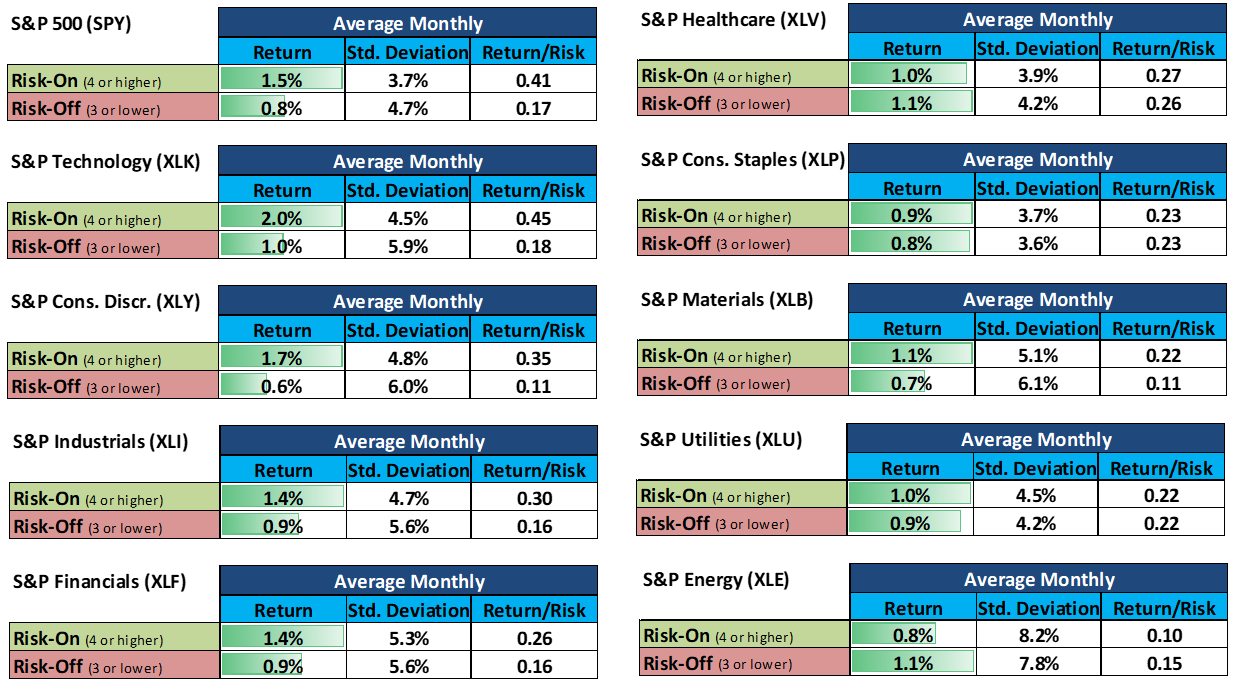
Successful long-term investing is less about identifying the next "moonshot" and more about the preservation of capital during major cycle turns. The LOGIC Macro Regime Framework is a systematic, rules-based process grounded in observable macro relationships and historical back-tests. By removing human bias and the siren song of narratives, the framework identifies "Risk-On" vs. "Risk-Off" signals with institutional precision.
Our back-tests demonstrate that the framework’s historical usefulness lies in its ability to identify the "Risk-Off" signals that precede major drawdowns. Avoiding a 30% to 50% decline is mathematically more important to compounding than capturing the final 5% of a bull market.
The Monthly Macro Map provides a forward-looking 6 month regime bias, allowing for proactive adjustments in sector style and ETF implementation.
Conclusion: Navigating the Future with a Macro Compass
As global debt dynamics continue to evolve and the sensitivity to liquidity reaches new heights, the investment landscape will become increasingly macro-driven. The era of passive, index-only investing is being challenged by the reality of fiscal dominance and volatile liquidity cycles. In this environment, understanding the cycle is not an option - it is a prerequisite for survival.
LOGIC Macro Regime is more than a set of indicators; it is a decision-making framework and a portfolio overlay designed to help you navigate the next 6 months with confidence. It allows you to move from being a victim of the news cycle to a master of the macro map.
Is your current portfolio positioned for the regime that just ended, or the one that is about to begin?
Stay Systematic.